Don’t Call It Rugby; Its A Different Ball Game.
Don’t Call It Rugby; Its A Different Ball Game.
Posted on Tuesday, February 18, 2014 by ARFAI,
Courtesy: dnaindia.com
Published: 5th September, 2013.
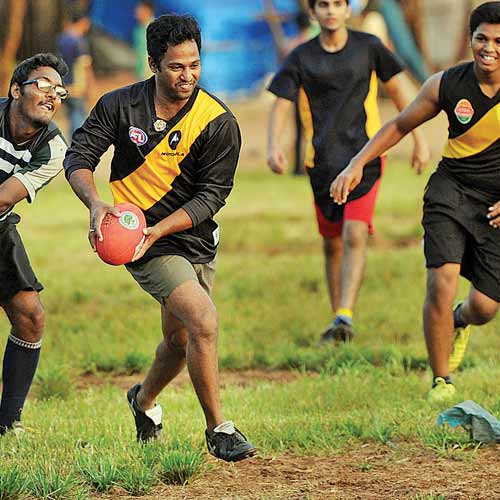
Every Sunday, a group of youngsters gather at Shivaji Park cricket’s hub to play a sport that appears to be a mish-mash of basketball, volleyball, rugby, sprinting, and football.
Curious onlookers fail to guess the name of the sport in three chances. Most believe it is rugby. However, some get it right once a hint is thrown that it was invented in Australia 155 years ago and is the most popular sport there.
If you have guessed it as Australian Rules football, you are correct. More popularly known as Footy, it was introduced to Australian cricketers to keep themselves fit during the off season. If cricket binds India, Footy does the same Down Under and is their national sport.
Well, it’s no coincidence that it took a legendary cricketer to introduce the sport in India. It was none other than Ricky Ponting, who introduced the sport to his Kolkata Knight Riders teammates during the inaugural edition of the IPL.
However, the sport was introduced in Mumbai by a much-lesser known Australian named Lincoln Harris, who owns a travel company called ‘India Unbound’.
The sponsorship for the sport in the city comes from India Unbound and a charity Australian Football club named ‘Reclink Football Club’, of which Lincoln’s brother Rhan Harris is an ambassador in Australia.
Footy is being kicked around in more than 50 countries now, including India. An International Cup is held every three years in Australia, where 18 countries participate.
Playing the most crucial role in the development and growth of the sport in the country has been Sudip Chakraborty, the secretary general of Australian Rules Football Association in India and operating as the official contact in India for the governing body of the Australian Football League (AFL), which has its headquarters in Melbourne.
Talking about the scene in the city, Sudip says, “Mumbai has always been welcoming to any new sport. What works in our favour is footy brings people from any sporting background together.
“The major chunk of AFL players in Mumbai come from Mahim, Matunga and Dadar and a few from Nerul. Their age group varies from 10-22 yrs.”
Sudip was a Mumbai University student, when he first represented India in 2008 and later went on to lead India to its first international victory against East Timor in the International Cup held in Melbourne in 2011.
The game has spread mostly through word-of-mouth, explains Sudip, “That’s why most of our players are from areas closer to Shivaji Park.
“Also, youngsters talk about the sport in their schools and colleges. This spreads awareness about the sport,” Sudip adds.
Mumbai had two teams fighting for top honours last season Mahim Cats and Matunga Tigers. The lads were divided into three age groups U-14, U-18 and an open age group, to fight it out in a best of three format.
The Mahim Cats emerged victorious in the U-14 and open-age encounters while the Matunga Tigers ran away with the U-18 honours. This season sees the introduction of the Dadar Lions, who hope to upset the two heavyweights.
Sumesh Sawant, 18, handles the operations of the sport across the state, and along with Lincoln is responsible for giving the sport the little reach it has in the city.
“I got the belief in the sport knowing that there’s a national team and a captain who is interested in giving the sport the exposure it so badly needs,” says Sawant.
“The best part of the sport is that it can be played at any sporting ground. So in a city like Mumbai where space is such a big issue, playing Footy can never be a problem,” he adds.
Both Sumesh and Sudeep believe that as youngsters nowadays are open to try out something new, something international, Footy has every chance to grow.
“We hope the sport reaches the level here it sees in other countries. The signs have been positive so far and the numbers turning up every weekend at Shivaji Park has been impressive,” said Sudeep.
Know Footy
First National Championship: November 2012 in Kozhikode
2013 National Championship: to be held in Goa from November 15-17
Playing area of pitch: 150 metres (or more) long goal to goal and 135 metres (or more) wide boundary line
Team strength: 18 players (4 rolling subs, squad of 22)
Length of game: four quarters of 20 minutes each
Scoring and Play
The game starts like a basketball game (jump ball), one runs with the ball like in rugby, you have to pass the ball (can pass forward unlike rugby) like you serve in volleyball (underpass). One can also kick the ball
The game involves scoring between two sets of four poles on sides of the circular pitch, two tall ones and two short. If one kicks between the two tall posts, six points. And between the tall and short, one point
The ball bears a striking resemblance to the one used in rugby but it is more rounded and more swelled up, helping players kick the ball a further distance.
AFL India organises footy tour from Australia for India’s National AFL Cup
Posted on Tuesday, February 18, 2014 by ARFAI,
Courtesy: eastasiaafl.wordpress.com
Published: 4th August, 2013.
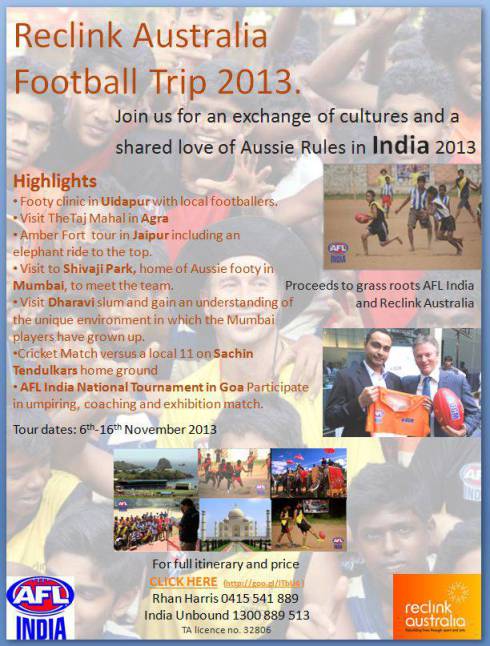
Reclink Australia and AFL India are organising a tour from Australia to India for the National AFL Cup which will be held in Goa on 16 & 17 November, 2013.
The tour is ideally suited for people looking “for an exchange of cultures and a shared love of Aussie Rules in India”.
Highlights of the trip which will run from 6 – 16 November, 2013, include:
Footy clinic in Udaipur with local footballers
Taj Mahal, Agra
Amber Fort, Jaipur (with elephant ride)
Shivaji Park, Mumbai – home of the Aussie Rules team which they will meet
Dharavi Slum – where the Mumbai players grew up
Cricket match against a local XI team on Sachin Tendulkar’s home ground
AFL India’s National Tournament, Goa. Opportunities to umpire and coach and an exhibition match
For full itinerary and price, click here.
Reclink Australia and AFL India
Reclink Australia’s mission is to encouraging people experiencing disadvantage to become actively involved in sport, recreation and arts programs to ensure positive health outcomes throughout the community
AFL India’s mission is to promote participation in Australian Rules Football in India; to use football as a means of social engagement; and to foster relationships between Indian Aussie Rules communities in and outside of India.
Related item
The Vietnam Swans have been hosting the ANZAC Friendship Match in Vung Tau (near Saigon) since 2010. The match is used as a vehicle to “Honor lost lives; save young lives”. Funds and awareness are raised to support the local orphanage and Swim Vietnam (in Vietnam, more children die from drowning than road accidents).
For next year’s ANZAC Friendship Match in 2014, Golf Life Tours will organise tours from Australia and donate money to these two causes.
Enthusiastic Participation For Australian Rules Football Tourney in Mumbai
Posted on Tuesday, February 18, 2014 by ARFAI,
Courtesy: sportskeeda.com
Published: 12th June, 2013.
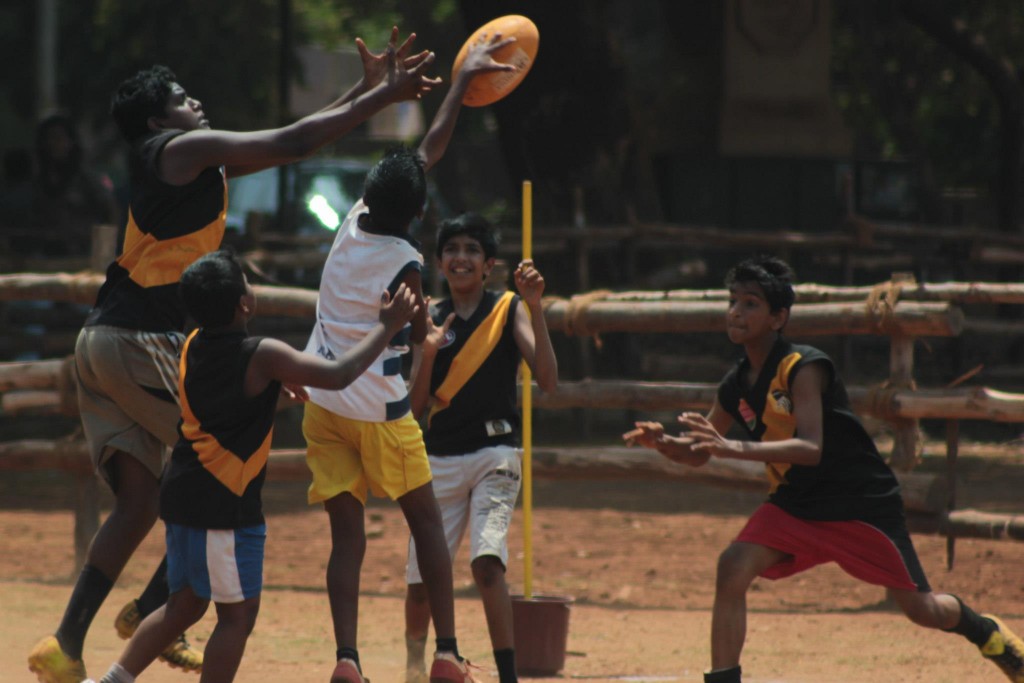
It was that kind of a summer afternoon in Mumbai where people would rather stay indoors than venture out in the scorching heat outside, let alone play under such conditions. Good luck getting that through to the 80 odd kids who turned up to play in an Australian Rules Football tournament in Mumbai, a considerably bigger affair than last year’s inaugural tournament. No wonder they’re always using the word ‘madness’ in the same breath as ‘Footy’. Well, madness it is and we love it!
Shivaji Park provided the setting for the clash between the Matunga Tigers and the Mahim Cats, the 2 local Footy teams in Mumbai. The lads were divided into 3 age groups viz Under-14, Under-18 and an open age group, to fight it out in a best of 3 format. Lincoln Harris of India Unbound and Sudip Chakraborty, captain of the Indian Tigers were the special guests, but they went a step beyond, with encouraging speeches and actually played against each other, representing the teams in the open age group final. They also donned the ref’s jersey and officiated in a few matches. Incidentally, Sudip had made his way straight to the ground after a 30 hour long train journey from Kolkata.
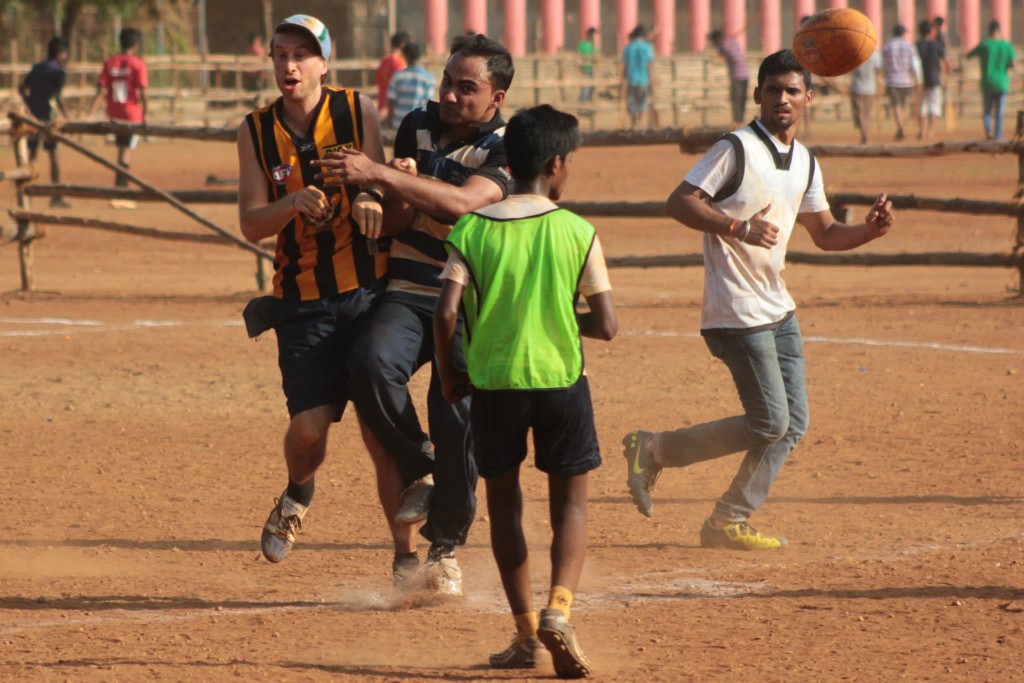
The history of Footy in Mumbai can be traced back to 2011, when Lincoln started to kick a Footy around with kids in and around Shivaji Park. He went on to help grow the sport by providing the basic equipment and occasional financial support to help sustain the momentum. The bulk of financial support required to pull-off this particular event was also provided by Lincoln himself. However, each player chipped in to ensure they had sufficient funds in place. What made the tournament pleasantly unique was the fact that few of the parents, apart from being present the entire day, actually prepared lunch and refreshments for everyone present. To top it off, there was also a never-ending supply of lemonade and ORS to keep the players hydrated in such demanding conditions. What a lift for the boys it was!
The matches themselves were hard-fought, close encounters. The boys seemed to be enjoying themselves, trying out their skills in this relatively new sport and they were keen to learn from the experience of Sudip and Lincoln. The Mahim Cats emerged victorious in the U-14 and open-age encounters while the Matunga Tigers ran away with the U-18 honours. But the day wasn’t about medals and trophies; it was a day to throw caution to the wind and experience the madness, the Aussie way! From Sudip’s perspective, who has been working tirelessly for the past few years to develop the sport in the nation, it was a moment of immense pride to see the local lads, led by Sumesh and Mayur, take the initiate and execute it in a most professional manner. “It’s the first time that a Footy tourney has been organised in India without any direct involvement from my side…it was an overwhelming experience…can’t really explain!”
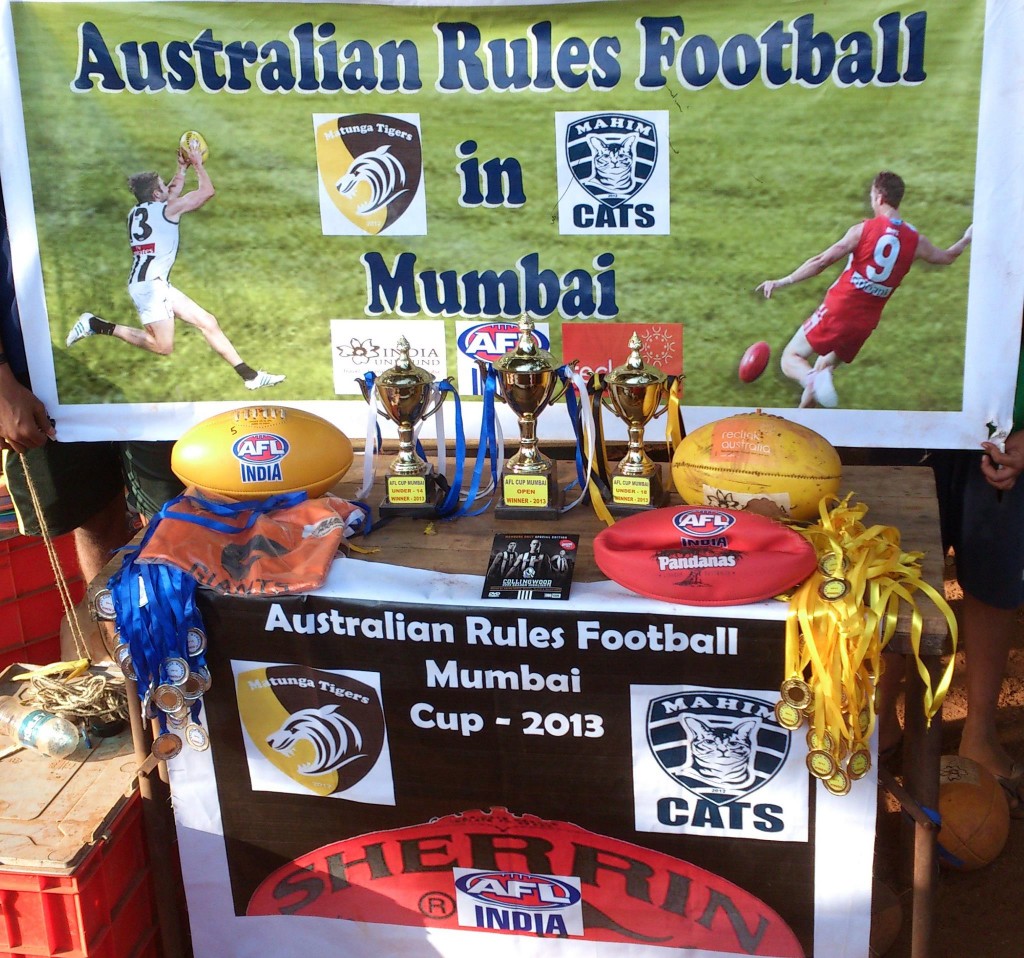
The tournament in itself was not the kind of affair that would make people sit up and take notice, but for the people at the Australian Rules Football Association in India, it was an encouraging sign of growing interest and a marker for the days to come. It served up a delectable concoction of excitement and passion, along with some valuable lessons learnt. The lads were over the moon to find the tourney covered in a local newspaper the next day. A proud moment it was for Footy in India, and a worthy example to follow for the rest of the nation.
Australian Rules Football in India
Posted on Tuesday, February 18, 2014 by ARFAI,
Courtesy: sportskeeda.com
Published: 21st April, 2013.
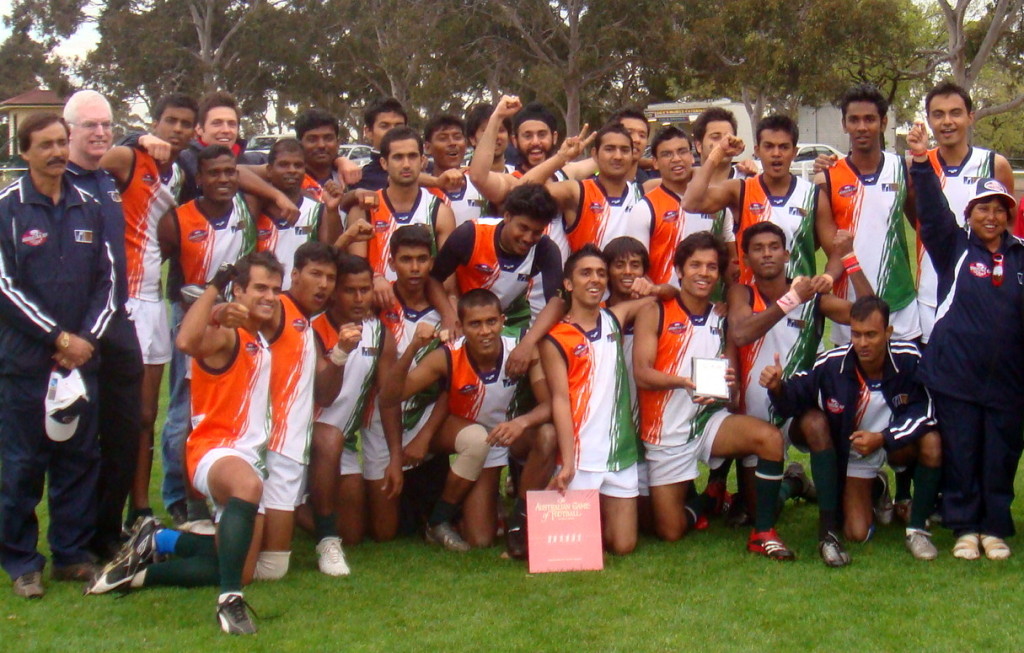
The Indian Tigers after their maiden International Cup appearance in Melbourne, 2008
The look of sheer surprise on the faces of Indian sport lovers when you mention Footy is completely justified. In a nation whose population is predominantly influenced by cricket and football, Australian Rules Football (popularly coined as Footy with reference to the ball) is as alien to them as the Aussie accent itself! But times are changing…and fast.
Back in 2008, when Ricky Ponting started cross-promoting the sport while at Kolkata Knight Riders, it marked the beginning of a period of swift progress in terms of popularity, and today Footy is being kicked around by more than 1000 players spread across 5 states. What is even more encouraging is the fact that a team representing India, called Indian Tigers, has participated in the last 2 International Cups (the Footy equivalent of World Cup), even managing their first victory against East Timor in the 2011 edition.
Instrumental to this progress has been the undeterred commitment of young Sudip Chakraborty, presently functioning as the Secretary General of Australian Rules Football Association in India. Taking a strong interest in the sport in 2008, he continued his voluntary association with the sport, working towards its development. In the process, he went on to lead India at the International Cup in 2011. Sudip put a lot on hold to operate as the official contact in India for the governing body of the Australian Football League (AFL), which has its headquarters in Melbourne.
Sudip has been a part of the Indian Tigers team since 2008, and in the same year the team representing India made its international debut against the Chinese Demons, as preparation for the International Cup ’08. India gave a good showing in IC08, pushing the Finland Icebreakers and the Chinese Demons to nail-biting finishes. But the greatest positive from the tournament was perhaps the opinion of AFL dignitaries, who regarded the performance of the Tigers as the best showing by a debutant in an IC.
The build up to the International Cup in 2011 saw a flurry of activities, including a visit from the legendary Brett Kirk of Sydney Swans and a first sponsorship from Lingona Pvt. Ltd. The International Cup 2011 itself stood witness to the remarkable progress made by the Tigers as they fought their way to a maiden international victory, beating East Timor 9-6-60 to 8-5 -53 in a thrilling encounter. Nail-biting finishes against the Chinese Demons and the Peace Team (Israel and Palestine combined) ensured the Tigers a finish above the Demons and East-Timors in the final rankings. Celebrations ensued and the foundations were well and truly laid for concrete future progress.
The development work got more impetus and gathered speed as more support flowed in for Sudip’s endeavours. Rajeev Tharani, the Secretary of Kozhikode District Olympic Association in Kerala and a personality dedicated towards development of 8 different sports in the state, expressed his interest in promoting Aussie Rules Football in his state.
Perhaps the most unfathomed, yet welcome support of all came from the Trade Commissioner for Australian Trade Commision in India, Tom Calder. A Footy fanatic and ex-footy player himself, he took out time to personally help Sudip in his efforts, and over the months has developed a fantastic working relationship with the people on-board, especially Sudip.
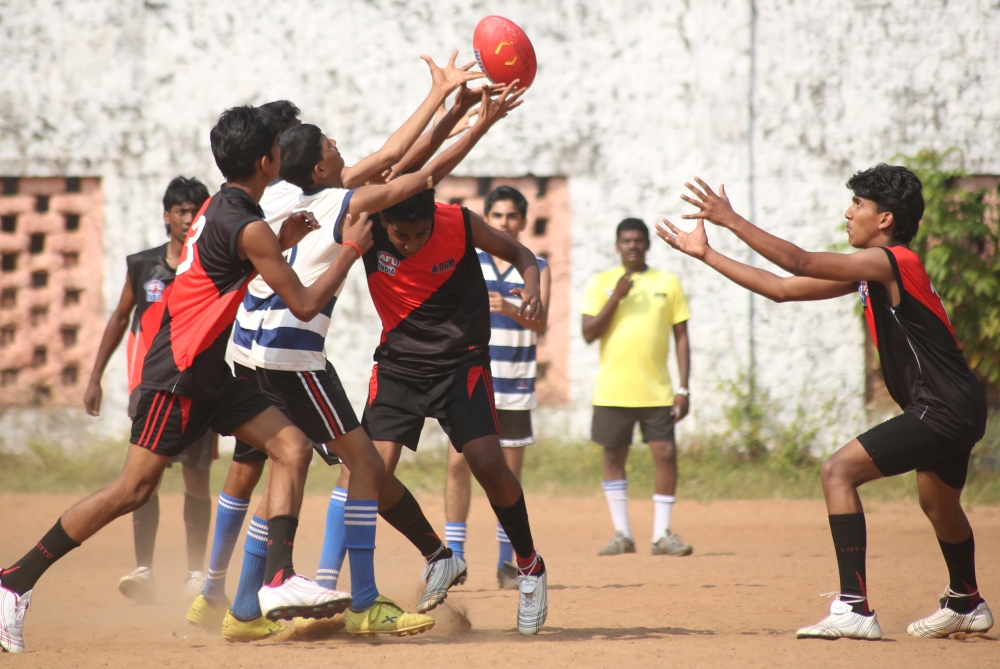
Action during the inaugural National Championship AFL India-OGM Cup at Calicut in December 2012
Like most sporting propagation agendas, Footy in India also desired some much needed inspiration from foreign lands, and it duly arrived in the form of Lincoln Harris of Australia Unbound and Rick Shrowder of Global Community Sports, who helped along the development through social angles and education in Mumbai and Madurai respectively. However, the push really came to shove through the sweat and toil of local lad Sudip who travelled his way all around the country, sowing the seeds of Footy and digging out potential takers.
30th November 2012 witnessed a momentous event for Footy in India. In a meeting held in Calicut, the decision to form a national federation for Australian Rules Football in India was made and the formalities were taken care of that very day. Mr. P.A.Hamza, Joint Secretary of the Indian Olympic Association, also lent a helping hand and his presence as the President of the Indian federation will surely help the cause. Footy in India has not looked back since.
In December 2012, Kozhikode hosted the first National Championship where 5 teams participated. Teams representing Maharashtra, Tamil Nadu and Kerala contested for the OGM Cup, inaugurated by Dr. Muneer, honourable Minister of Social Welfare and Panchayat, Government of Kerala. The final saw two teams from Kerala fight for the cup, with North Kozhikode Bombers defeating the South Kozhikode Giants to clinch the trophy.
Recent development has seen AFL-India spreading its wings to Gujarat where the interest in the sport has reached the pinnacle of political setup with the Chief Minister, Mr. Narendra Modi, himself expressing his desire to facilitate developments. The past few weeks have also seen significant progress regarding financial support and professional setup.
The present may leave much to the imagination but the steady progress is a mark for a brighter future and it is the belief to challenge the best in the sport that will surely drive the likes of Sudip and co. into bigger, swifter developments.
It’s Footy Fever, mate!
Posted on Tuesday, February 18, 2014 by ARFAI,
Courtesy: sportskeeda.com
Published: 11th March, 2013.
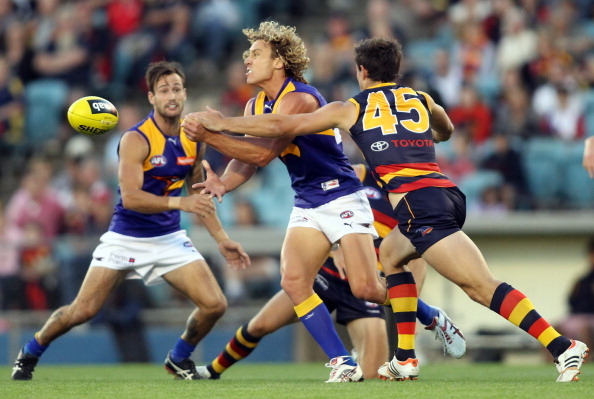
18 players a-side on a huge oval field, fisting a rugby-like ball, kicking it through sky-high posts, and almost a hundred thousand crazy fans raising the roof of the stadium – obscure it may seem to the uninitiated, but ask your Aussie friend about it, and see his eyes light up. Its more than a sport in the Land of Kangaroos, it’s almost like a religion; a force that binds the whole nation together. That’s Australian Rules football for you – the national sport of Australia.
The game of Footy (a popular term for the ball used in the sport) has been played in Australia for more than 150 years now. Despite its long standing presence, the sporting world outside Australia still identifies the nation with hockey and cricket. Incidentally, back in the day, the sport was introduced to keep cricketers fit during off-season. 155 years down the line, Footy has eclipsed cricket to become the most popular sport in the country, with cricket languishing down in 4th place in terms of mass popularity. “Cricket’s worst creation!” the cricketers in Australia call it now.
To the untrained eye, the sport looks a lot like rugby on first sight. However, it is anything but. The sport, in fact, requires skills from various other sports like basketball, volleyball, football, and yes, a bit of rugby as well. Most of the venues are originally cricket grounds, hence the oval field and the extra players on each team. Because the sport is played on cricketing venues, the players have to put in that extra mile during the game, making this, statistically, the sport where a single player covers the highest distance, averaging 8.5 miles per player per game.
For a sports lover whose heart races with the excitement of outdoor team sports, it is almost impossible to not like Australian Rules Football. It is a free-flowing game with very few stoppages, and record-keepers identify it as the fastest outdoor team sport in the world. Played at breath-taking pace for 80 minutes (20 minutes per quarter), this sport is more about skills, speed and endurance than physical dominance.
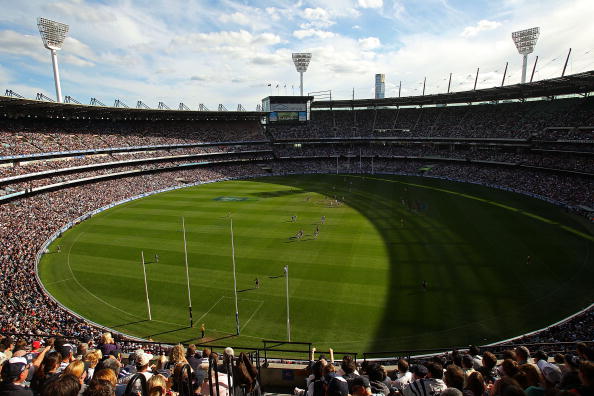
What adds to the charm of the sport is the atmosphere surrounding the stadium on match-days. Colourful, vibrant, buzzing with euphoria; the fanatics of the game flock to the stadiums as if every game was a title decider. Speaking of which, the Grand Final of the Australian Football League (AFL), held in the Melbourne Cricket Ground (MCG), attracts more spectators (100,000 on an average) than any other sporting final in the world. Unsurprisingly, the AFL holds 4th position on the ranking of professional sports leagues around the world in terms of attendance per match.
Internationally, the AFL has been trying to promote the game for about half-a-century. The Footy is being kicked around in more than 50 countries now, including India (more about the Indian scenario will follow in future articles), and an International Cup is held every 3 years in Australia, where 18 teams representing their nations participate. Australia itself is an absentee from the cup by virtue of being leaps and bounds ahead of the rest in the sport; a noble exclusion to give other nations a fair chance. Australian Football has also succeeded in bringing together a Peace-Team comprising players of Israel and Palestine, something even the UN has failed to pull off so far.
Footy fans around the world are sensing exciting things ahead for the sport, and rightly so. The sport brings with it all the excitement that sports lovers could hope to dive into when they behold a sporting spectacle. The high-octane nature of the game is sure to catch on fast, and the people at AFL must be hoping Australian Football will scale the heights achieved by other popular international sports.
AFL India Creates Government Links In The States Of Gujarat & West Bengal
Posted on Tuesday, February 18, 2014 by ARFAI,
Courtesy: worldfootynews.com
Published: 23rd February, 2013.
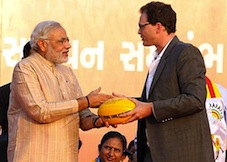 Australian Trade Commissioner and Vice President of Australian Rules Football Association in India, Tom Calder, was special guest at the closing ceremony of the “Swarnim Khel Mahakumbh” in Ahmedabad, a mass scale sports carnival organized by the Gujarat state Government as a part of the program to celebrate 50 years of the formation of the West Indian state.
Participation at the event saw nearly 1.3 million participants of various ages competing in 24 different sports at 1,100 venues across the state. The event is the brainchild of Chief Minister Narendra Modi who has a strong pro-sports agenda and who declared in his speech that the carnival would become an annual event.
During his speech at the event Tom asked the Chief Minister to consider promoting the unique Australian sport in Gujarat as a way of increasing Australian-Gujarati sports links and presented an AFL India branded Sherrin to him on stage (pictured at left).
Tom, who is a Saints tragic and a passionate supporter of Footy in India, received some strong interest in exploring AFL further at the event, including AFL India conducting a two day workshop for PE teachers in Ahemadabad.
AFL India had earlier earmarked Gujarat as a state with good potential to kick off footy and now has a great starting point with the highest possible source in the state, Narendra Modi, who is tipped by many as the Prime Ministerial candidate for the opposition party in India, for the upcoming national elections in 2014.
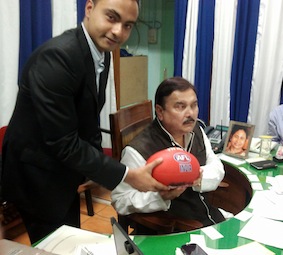
Also in the state of West Bengal, the place where it all started back in 2008, I got the opportunity to introduce Footy to the Sports Minister Mr. Madan Mitra (pictured below) recently.
Both these links have paved way for registering the state associations in the respective states in near future, with activities up and running in Gujarat from the end of this month.
Football diplomacy at its best!!
AFL India Writes To The EAAFL
Posted on Tuesday, February 18, 2014 by ARFAI,
Courtesy: eastasiaafl.wordpress.com
Published: 8th february, 2013.
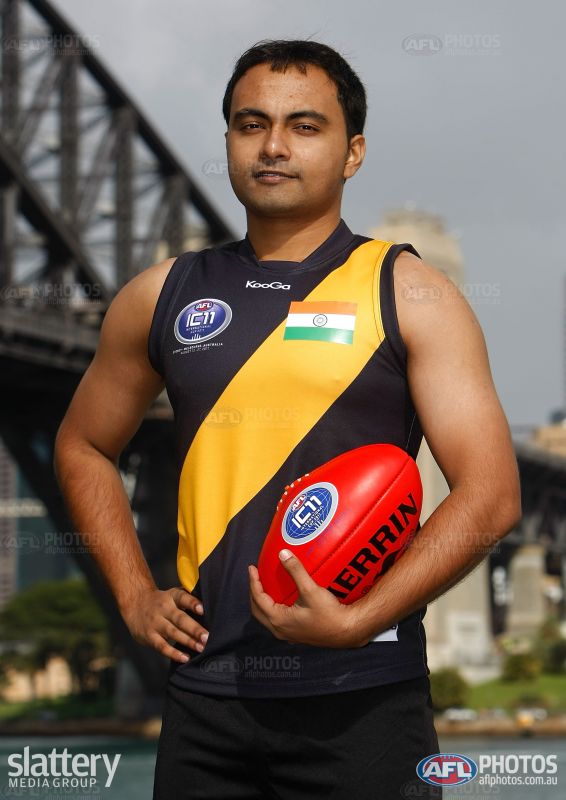 Sudip Chakraborty, Secretary General of the Australian Rules Football Association in India has written to the EAAFL in which he describes developments in India and the EAAFL.
His email is reproduced below.
Hello everyone,
Thanks for Including me in this conversation and offering India to become a part of the EAAFL. We would be more than happy to do so. But there are quite a few points that doesn’t put AFL India in the same league with you all at the moment –
AFL India comprises 100 per cent Indian participation and there are no expats playing in the country. Also the only country so far where promotion of the sport has been almost completely driven by the indigenous people. Although we can try and have 4-5 expats join the team if/when required.
We are concentrating on junior development and the newly formed clubs that exist consist of players ranging from 12-25 years old. The only completely senior team that exists is that of the Indian Tigers which represent India at the AFL International Cups. Having worked with AFL Europe for my research on ‘How to promote AFL in Europe’, the biggest outcome has been ‘necessity of junior development programs among the locals’. So we are going the bottom up direction. The next few months will see us dedicate our time to conducting school clinics, a joint effort by AFL India and Global Community Sports. Looking forward to explore opportunities of conducting similar clinics in schools of your countries as well, if anyone is interested.
We started the national championships last year and have decided to make that an annual event, and we will hopefully organise it in Goa this year, a foreign tourists’ paradise in India. Will update you all on the same when things are confirmed and will invite everyone to come over if possible. Along with the national champs, we have thrown open the idea of having a few full-contact games between senior teams, which enables the Indian senior team to participate, along with a club from Dubai, maybe Donguan and I was told a team from Indonesia might be on the cards.
We are also going in a very structured manner and have registered a national federation for Aussie Rules in India with the Indian Government and are registering state bodies under the national body. Once we have 8 registered states, we become a national sports body, can call the Indian Tigers team for AFL International Cups as the Indian National team and also get access to annual grants from the Sports Ministry. But this process has seen myself step down from the President’s post, which has been accepted by the Jt. Secretary of Indian Olympic Association, while I continue my work as the Secretary General. We are looking forward to be accredited by the Indian Olympic Association in the future.
Now coming back to the EAAFL competitions, India is more than happy to join the league, but sponsorship for all the expenses is the major issue. Hope we can work that out slowly and India can be a full time member in a couple of years. We need our own sponsors here to fund the national champs later this year and the Indian Tigers for International Cup 2014 apart from the developmental activities.
If some limited sponsorship is available, I would like to come down to Bali or Balikpapan and experience how the set up works. Am looking forward to work with the AFL in the near future and all the experiences of footy around the world would enable me to fight a stronger case for international footy wherever possible.
Looking forward to hear all your opinions and more than happy to share more information.
Thanks everyone once again.
It Ain’t Cricket
Posted on Tuesday, February 18, 2014 by ARFAI,
Courtesy: australiaunlimited.com
Published: 22nd January, 2013.
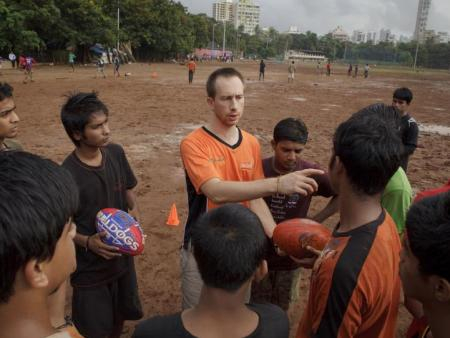
One per cent of India’s population is roughly half Australia’s population. So a significant fan base could emerge from converting a small percentage of that country’s bat and ball fanatics to a brand new game.
A young man who wanted to direct Bollywood films; a tour operator stationed in Mumbai; and a UK-based educator – yes, it sounds like the start of a joke. But for Sudip Chakraborty, Lincoln Harris and Rick Shrowder the sport of Aussie Rules is more than just a lark. This triumvirate, very different backgrounds and interests notwithstanding, is passionate about India and also about Australia’s native football code.
Until the end of 2012 the three worked mainly independently of one another, but in December they met at the first Indian national Australian Rules Championships in the southern state of Kerala.
In India, as we all know, cricket is more than just a game. It’s the game. Up to 80 per cent of the country’s 1.2 billion inhabitants are thought to watch or play it in some fashion. Almost 68 million Indians tuned in to watch their side win the 2011 World Cup. The major international series – the Indian Premier League – has a market value estimated at $US3billion.
Getting traction in India with big global sports is hard enough, but Australian Rules Football? It’s little known and little played outside Australia – except by mad ex-pats set on world domination by their sport.
The plan for Kerala was to formulate something of a roadmap for the future of the sport that already has around 500 registered players and a presence in four of India’s 28 states.
In many ways Chakraborty has been the glue in this equation. He’s the local who has effectively dedicated his work, sporting and social life to a sport he knew nothing about until seven years ago.
Unsurprisingly it was a cricketer – former Australian captain Ricky Ponting – who stoked the flames of Chakraborty’s interest in the code when the Australian was cross-promoting AFL in 2008, during a stint in the Indian Premier League with the Kolkata Knight Riders.
Already playing a loose version of the game in Kolkata, Chakraborty was lured by the promise that a team from India would feature in an international Aussie Rules tournament to be played in Melbourne (the heartland of AFL passion) and Victorian regional cities Geelong and Warrnambool later that year. It was an irresistible challenge for the teenager, who put his studies on hold to dedicate himself to the sport as he sought to make the team.
The International Cup of 2008 would yield no results for the raw Indian squad, but getting to watch some of the game’s greatest players in action in the AFL was enough to convince Chakraborty he would embrace the code and encourage others in his homeland to play the foreign game.
“I got to see (Hawthorn’s) Buddy (Lance) Franklin kick his 100th goal. It was crazy, it was overwhelming and the experience just made me love life,” Chakraborty recalls.
But there was to be no immediate fairytale for the sport in India. After initial enthusiasm the code’s peak body there disbanded. Chakraborty was left to pick up the pieces and form a new board.
Things moved slowly, but the new Australian Football League – India gradually took off, and the body saw teams playing in Mumbai, Calicut and Madurai. Funds were always tight and pushing the value of such a minor sport was sometimes tough, but a visit from former Sydney Swans captain Brett Kirk at the start of 2011 as part of his worldwide tour to promote the game left its mark.
“The two weeks I spent with Brett Kirk were absolutely life changing for me,” Chakraborty says. “He kept talking about my passion but what I saw in him inspired me more. I was doing my graduation in mass media and was looking forward to becoming a Bollywood director but he changed everything for me. I thought, ‘I need to do sport management and take things more seriously’. And that’s when footy became my life.”
Chakraborty would go on to become president of AFL India and captain the national team to its first win at the International Cup in 2011 against East Timor. He’s now looking at taking up a formal position with the AFL in Australia in 2013.
For Lincoln Harris, who started taking small groups of tourists to India 10 years ago and now runs the award-winning Mumbai-based business India Unbound, the AFL push is less about the sport and more about the connections that Indians from all walks of life can make by playing Aussie Rules. He loves the game, to be sure, but when he suggested kicking a ball around instead of playing a semi-regular game of cricket with some friends and locals a few years back it was initially just to try something different. He soon realised it could be a chance to kick more important goals.
“Everyone was keen on the game as something different to cricket,” he says. “And to teach people something new is a powerful thing because that levels the playing field. Everyone comes in with the same skill or lack of it. They forget their background. It doesn’t matter where you come from or what your physical attributes might be, you are starting from square one. Often in India people’s backgrounds weigh quite heavily on what they do, who they associate with and the networks they have. For me the idea was to start connecting people from different communities.”
And that’s exactly what started to happen. The Wednesday training and Sunday games played at Mumbai’s Shivaji Park (where the cricket connection also runs deep – one of the world’s greats, Sachin Tendulkar, began his career playing here) quickly became a melting pot of university students, the middle classes as well as those not so well off, all of whom found the new game addictive.
With the help of non-government organisations, the Australian Trade Commission, as well as some of his own hard-earned cash, Harris found himself running a half-decent local competition. A subsequent contact with Chakraborty opened up more doors and also ensured Mumbai’s two teams – the Mahim Cats and Matunga Tigers – would get to travel to Kerala for the national championship.
Cricket’s legacy, it seems, is both a blessing and a curse. Harris believes there are plenty of Indians who are a bit over the ubiquitous national game, and ready to take on another sport. But the shadow cricket casts means it can be difficult for other sports to find their place in the sun. Money and influence for Aussie Rules, and indeed most other codes, is hard to come by in India.
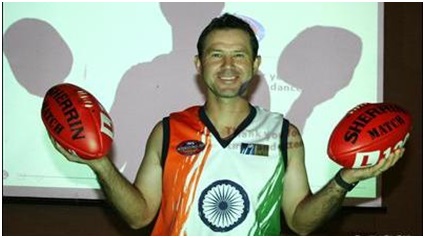
“If you had a bit of organisation behind you, you could get thousands of people playing in a short period of time,” says Harris.
Enter the AFL’s Richmond Football Club. The Tigers began establishing links with Australia’s Indian population in 2010. In a multi-tiered strategy the Melbourne club thought it could build a few bridges when the city’s reputation took something of a beating in India after several international students were attacked in the Victorian capital. There was also the opportunity to grow their own fan base and begin to engage with Indians in India – where the tiger is also revered.
The cricket connection was again ever-present with legendary Indian batsman Rahul Dravid coming on board as patron for the 300-member strong Indian Tigers supporters’ group. The club also hosted the Indian national team in 2011, Indian kids for little league games and has established the Masala Football Club in Melbourne.
That’s an Indian, Pakistani and Bangladeshi Australian Rules team that will play in Melbourne’s amateur competition for the first time in 2013. There are also plans afoot for a pre-season AFL game, potentially against Greater Western Sydney, to be played in Mumbai in the next two years.
Business, sport and social cohesion are all worthy drivers for Australian Rules in India but UK-based Rick Shrowder has yet another: education. The former Adelaide local has lived in northern England for the past 13 years where he set up a sports-based educational program called Global Community Sports, delivering programs to primary and secondary schools and young offender institutes in the region. Australian Rules is his sporting tool of choice. After seeing a television show on aid in India, Shrowder thought it would be a worthwhile exercise expanding his program to the sub continent.
He set off in 2007 to do just that.
The project has gone on to become education with a unique twist. Shrowder gets his UK students to put together manuals with words and pictures to explain in their own way how the sport works and what they have learned during their six-week program. Since 2010 the manuals have been used to introduce more than 500 people to the sport in Madurai, in southern India.
“Teaching them Australian football, they are learning about a lot of issues,” Shrowder says. “You can talk about community cohesion, diversity and an introduction to the country of Australia.”
He can see the code growing to become a more substantial national league and with the right assistance a part of a wider education program in Indian schools.
“Sport is a great way to engage with young people. For literacy, numeracy and greater learning. The bigger it gets, the more people will have value in involvement from administrators to coaches or umpires.”
Just how big Aussie Rules can become in India is anyone’s guess. While it will never challenge cricket and is unlikely to go head-to-head with big global sports such as Formula One and soccer, the key players feel it can significantly grow its niche. And with passionate proponents such as Chakraborty – whose ultimate aim is to organise a match between India and Pakistan to bring the countries together – the game’s potential suddenly seems very big indeed.
« Previous
1
…
19
20
21
22
23
…
25
Next »













.jpg)