Tigers Expanding AFL Territory Across India
Tigers Expanding AFL Territory Across India
Posted on Monday, February 17, 2014 by ARFAI,
Courtesy: worldfootynews.com
Published: 16th November, 2012.
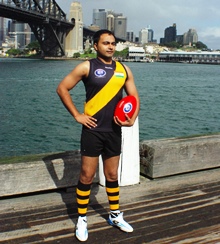 It has been over a year since India won its first international match of footy against Timor Leste during AFL International Cup 2011 on 24th August. A historic day in Indian sports history. A day that came after almost four years since India started playing the game officially.
After a fairly good show in the later stages of IC08, the players had gone back to a complete standstill for over a year, with the previous body in charge disappearing due to lack of interest and enthusiasm. That was when two of the players from the IC08 squad took up the challenge and got the AFL to dissolve the previous body and helped them set up a new board to get things going again.
It was a couple of years of total hard work to get the existing players as well as new players together to start training again in the city of Kolkata, in eastern India, where the majority was based. There were a lot of obstacles to overcome, but there were surely quite a few big positives, including spreading the game to a new city of Calicut in southern India, Brett Kirk’s visit to India leading to discovery of the footy factories in northern India and the prospect of having the AussieX programme in India, following their fantastic work in Canada. Captain Kirk’s visit was specially the most inspiring part, which helped India to build up stronger into IC11 and snatch their much awaited first victory away.
Ever since the IC11, things have progressed slowly but surely. This includes the big support from Richmond Tigers extending on to having the first ever clinic conducted by the club in India, reaching out to the students in Mumbai. This was added to the fantastic work done by Rick Shrowder and his company Global Community Sports, to spread the game among hundreds of students in the city of Madurai. While in Mumbai, it was the work of another Aussie Lincoln Harris of India Unbound, who has successfully set up two teams of teenagers, who train regularly with the footy.
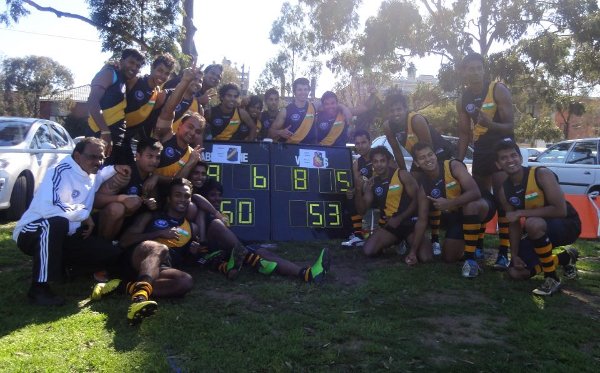
Meanwhile the AFL India President and the India Tigers Captain Sudip Chakraborty has completed his MSc Sport Management from Loughborough University in UK, and has successfully utilized his time in Europe to experience the footy action in UK while playing for the Wolverhampton Wolverines in the pre-season games and Nottingham Scorpions in the AFL CNE league. At the same time he worked on his Master-degree research on the topic ‘How to develop Australian Rules Football in Europe?’, with help from the AFL Europe General Manager Ben MacCormack. He also umpired for AFL Europe during the Easter series when the AIS Academy met the European Legions at London last year.
What lies ahead for AFL India is the first ever inter-city tournament in India, which will be played by teenagers from the cities of Mumbai, Calicut and Madurai, later in December this year. The governing body also plans to open up to Aussies in India and plans to grow from the grassroots and start school programmes. Hopefully in the next few years, there will be a potential market ready for the sport to spread rapidly and hopefully a junior development programme named ‘Indi-Kick’ can be implemented.
Footy Clinics Held In Kerala And Mumbai
Posted on Monday, February 17, 2014 by ARFAI,
Courtesy: worldfootynews.com
Published: 11th July, 2012.
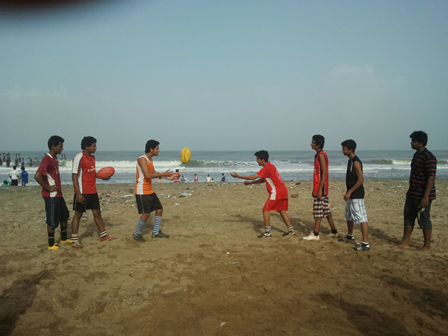
Passionate individuals remain the driving force behind football in India.
Rajeev Tharani, a last minute withdrawal from the India Tigers squad at the 2011 International Cup, has just concluded hosting a series of Under 19s football clinics in Kerala, a state in India’s southwest. An impressive 75 youths from throughout the state participated. Tharani’s focus now shifts to a 9-a-side tournament to be held in the coming months.
Meanwhile, at the opposite end of the country, expatriate Australian Lincoln Harris recently made mainstream news in Australia, for his work promoting football in Mumbai, and for using it as a tool to “bring people together”.
Hopefully these individuals’ efforts, coupled with Richmond and GWS’ interest in playing an exhibition match in India, can continue to raise football’s profile on the Subcontinent, resulting in funding that allows serious inroads to be made.
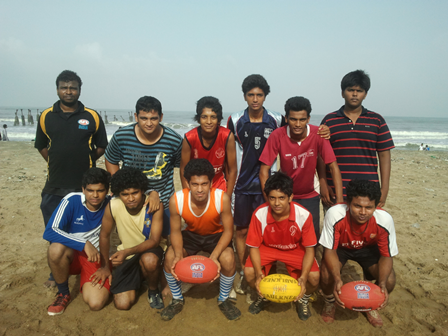
The World Game
Posted on Monday, February 17, 2014 by ARFAI,
Courtesy: theage.com.au
Publsihed: 17th June, 2012.
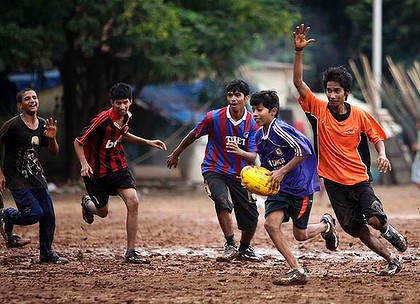
Fun is the key ingredient when young Indian boys play AFL in Mumbai. Photo: Kuni Takahashi
On a muddy piece of earth in the heart of Mumbai, children from the slums and India’s rapidly growing middle class pick up a grubby Sherrin, kick it to one another, then laugh.
It is a simple pastime, which many Australian youngsters have taken for granted for decades, but on the subcontinent these scratch matches mean so much more.
Australian expatriate Lincoln Harris introduced the oval ball last year to a small group of Indians in his neighbourhood.
“I started kicking the footy with a few young guys in the area where I live – middle class kids, just having a kick for fun. They really enjoyed it so I taught them the rules and .?.?. we tossed around some ideas about how we might be able to get the numbers together for a small match,” Harris said. “Then something occurred to me.”
Harris, who runs a travel company in Mumbai, said India is a divided country “in some ways” with few people from the slums and middle class interacting with one another.
He realised football had a “harmonising power” to break down this barrier, and was proven right. The kick-to-kick group has now grown to more than 40, who meet twice a week to train more or less in the dark on the edge of floodlit Shivaji Park, where a young Sachin Tendulkar cut his teeth.
“I thought that at a very local level, Aussie rules would be the perfect tool for broadening those networks by bringing together different communities in this area — the slum kids and the middle class kids – communities that normally have very little or nothing to do with each other, and literally live on opposite sides of the tracks,” he said.
“The physicality of the game, combined with the fact that everyone is learning something new, pushes everyone out of their comfort zone so they are less concerned about who they are playing with. Mix up the two groups and suddenly you have teamwork from people who otherwise don’t have much in common.”
Harris, inspired by Reclink Australia, which aims to better the lives of disadvantaged people though sport, hopes these scratch matches will grow into a small competition, which if successful could be replicated across India’s cities and become a national competition.
He said people often talked about wild dreams but unless they started living the adage of turning their words into actions, nothing would ever happen.
It is a view that is shared by the AFL’s international development manager Tony Woods.
Woods said football has long been able to bring people together since its birth more than 160 years ago. It has helped enhance the lives of people living in indigenous communities in Australia, rural localities where the only thing left standing is a wide green oval after the church, school and general store have faded away.
“The great thing about AFL and Australian rules is that it’s an inclusive game, and it’s a game that suits all shapes and sizes,” Woods said. “There is almost a paradox that we all share in the belief that it is the best game in the world and most spectacular, yet sometimes we are a little bit slow in opening our arms to letting other people play it.
“One of the keys to unlocking the [global] door is for the wider football community in Australia to embrace the concept and the belief that other people, other than Australians, can play the game and they can play it well.”
Last year, Australian rules broke the 100,000 mark in participation across 40 countries.
Woods’ passion is contagious and his voice speeds up a little when he talks about the future of the competition.
“You could theoretically, and I’m in the business of bringing the theory to reality, in the future have a forward line that goes something like a small forward that comes out of the highlands in PNG, supported by a hard-leading elite athlete that comes out of US/China, you have got two half-forward flanks that have been born and bred in the west of Sydney and they are roving of the ball of a 6’10 ruckman that was born in China,” Woods said.
“The only thing that stops you thinking about that is a limited imagination, because athletically China has won gold medals at the Olympics, PNG has, and you talk about a multicultural society in Australia where in another 15 years, 50?per cent of Australian families would have been born overseas. You only have to look at the diversity starting to come through the elite ranks of the AFL, the landscape is absolutely changing.”
While Woods recognises the work Harris is doing and the potential of tapping into the Indian market, particularly with the game able to played on the country’s many cricket grounds, the league has its sights first set on China.
“At the end of the day, AFL is played in some organised fashion, albeit small in a lot of cases, in more than 40 countries. Now, it would not be prudent for the AFL to be spreading their investment over 40 countries, so we have really got to ensure that our investment is smart and targeted and where we are getting genuine outcomes and look to build that over the coming years.”
The league held an exhibition match in Shanghai two years ago, and in February began plans for a development academy in Guangzhou in the country’s south, where about 104?million people live within a 100-kilometre radius.
Next month, those plans will become a reality when the first 30 Chinese athletes pass through the academy.
The two-week program will not only include an introduction to Australian rules football and Australian culture. It will be followed by two days of testing, with two athletes chosen to take part in the AFL’s annual draft camp this year.
Woods admitted a Chinese-born footballer might not be drafted to an AFL club next season, but believed it would happen in coming years.
“We are realistic to say that it might not be this year, but this is a tangible and genuine step to opening up that talent pathway from China into Australia,” he said.
“And that path will lead to Etihad Stadium one week after the grand final where the two Chinese athletes will test against the 110 best kids in Australia.
“We believe that if we can succeed in creating an opportunity for a Chinese-born athlete to ultimately play in the AFL, that will then help us connect our game more closely to the Chinese community in Australia. They still have a really strong connection back to mainland China and so ultimately our game is about heroes and if the community can connect to someone from their generational homeland, that is only going to help in engaging with AFL.”
But is not only in distant lands where AFL is making inroads. About 30,000 children in rugby-dominated New Zealand take part in KiwiKick, the equivalent of the Auskick program each week.
Woods stressed the league wasn’t trying to cripple rugby across the Tasman.
“At junior and grassroots level kids are really looking for an alternative to rugby. That has basically allowed soccer in New Zealand to get a foothold.
“We are not saying that we are going to take over rugby, but our position is that we are providing a genuine alternative to rugby, and the reality is some kids might be physically suited to playing rugby. If they want something a little more physical to soccer, AFL is a great middle alternative.”
It is something the South Africans have known for years. Outside the Pacific region it has the largest AFL participation.
“We have found there has been a really strong gravitation to AFL because our game, and this in the South Africans’ own words, you can use your hands and anyone gets a chance to score, and there is a lot of freedom,” Woods said. “There is a really natural synergy with the culture and the majority of the South African population.”
But escapism is not the only drawcard for Australian rules. Woods said the sport also helped instil good values in young people, particularly in Papua New Guinea, which has long struggled with violence.
“It’s a little known fact that there are over 100 football grounds in PNG,” Woods said.
“At junior level we have a very strong an enforced rule that if you partake in an act of violence in an AFL game at whatever level, not only are you suspended but you are ineligible for selection for talent squads and ultimately the national team, so it really works as a strong deterrent. The kids who are playing are seeing AFL as an opportunity to travel out of PNG and into Australia, and we are seeing that have an impact.”
As for Harris, he is happy with the progress of the Mumbai project, which he has funded himself.
“If you have a look at the Facebook page you will see the most recent post is about getting the boots. I bought these directly from the manufacturer in north India and the guys thought it was amazing. Yesterday we ordered 50 custom-made balls – in Richmond and Geelong colours – and we’ll approach the AFL or the clubs for some genuine stuff soon. We have banners, bags and drink bottles in team colours all in the works,” Harris said. “As much as anything else – and this shouldn’t be lost amid all the higher values stuff –it is about having fun.
“Indian kids know how to have fun, irrespective of their economic situation – foreigners often remark on this ‘but they are so poor, how can they be having fun’. All I am doing is giving them a better and more interesting opportunity to have fun, because not all of them get the opportunity very often.”
ONE GLOBE MANY OVALS
40 countries, 100,000 players
International cup: in 2011 23 teams took part representing 18 countries, including Japan, Ireland, Denmark, Sweden, USA and a peace team comprising both Israelis and Palestinians.
Papua New Guinea: played since 1930, has more than 100 football grounds across the country.
New Zealand: 30,000 children take part in KiwiKick, the equivalent of Auskick each week.
South Africa: first played in 1899 as a result of Australian Army involvement in the Boer War. In 2008 an AFL match was played at SuperSport Park, Centurion between Carlton and Fremantle in front of about 5000 fans.
China: the AFL will open a development academy on July 9 in Guangzhou, where about 104 million people live within a 100-kilometre radius. Two Chinese athletes will be selected to take art in the AFL annual draft camp this year at Etihad Stadium.
Richmond Launches Indian Tigers Supporter Group
Posted on Monday, February 17, 2014 by ARFAI,
Courtesy: worldfootynews.com
Published: 17th February, 2012.
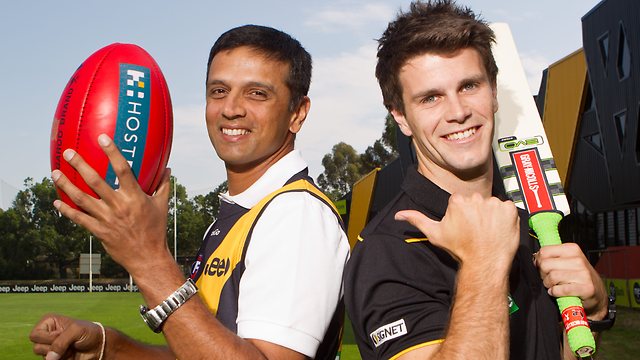
The Richmond Tigers Football Club has launched the Indian Tigers Supporter Group; an initiative to introduce Indians in Australia to footy whilst growing the club’s supporter base.
The Indian Tigers Membership, which is free, entitles eligible applicants to:
-Entry to any three home games in Melbourne
-A personalised 2012 membership card, stickers and lanyard
-A unique inner sanctum experience at the Round 3 clash at the club, before the game at the MCG
-Personalised communication from the club
-Priority access to finals tickets in weeks 1-3 if Richmond is participating
The announcement further supports Richmond’s commitment to the Indian community. Earlier in the week the club expressed a desire to play an exhibition match in India.
AFL India: Some Progress Being Made
Posted on Monday, February 17, 2014 by ARFAI,
Courtesy: worldfootynews.com
Published: 17th February, 2011.
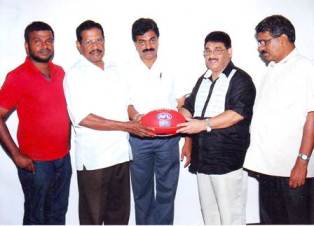 The India Tigers were somewhat of a surprise appearance at the 2011 International Cup. At their international debut at the same tournament three years earlier, the team failed to win a match and upon their return to India, the governing body disbanded. Whilst interest in the sport amongst the players was strong, channelling this interest into structured clubs participating in regular matches would prove impossible in the short term.
The AFL’s decision to again support an Indian squad, without any visible progress between 2008 and 2011 was controversial. Will this support pay off? We explore the progress football is making in India post IC11.
Kolkata, West Bengal
Almost the entire India-based contingent of the IC11 squad was based in Kolkata. Training sessions are scheduled to commence in late February 2012. These clinics will receive a boost in March when Mayank Shah, one of the Melbourne-based players, visits the city.
Kozhikode, Kerala
WFN first reported on Rajeev Tharani promoting footy in Kerala in May 2011. Tharani was supposed to be a part of the India Tigers squad for IC 11, however he was a last-minute withdrawal after being involved in a motorbike accident. Fortunately he has fully recovered and his clinics have resumed. These clinics have now been held in six schools. Apart from reaching more schools in 2012, early plans underway for an Under 19s Beach Tournament.
Elsewhere in India
One of the Melbourne-based India Tigers players, Priyank “PM” Chokshi has since returned home to India permanently. He plans to have a program running in Ahmedabad, Gujarat by 2013.
Similar plans are underway in Chennai, Tamil Nadu where the Cardiff Panthers-trained Srinath Lakshmaiya resides. Also in Tamil Nadu is the work of Rick Shrowder, via Global Community Sports.
AussieX is preparing to launch in India with the support of 2008 Olympic Gold winning shooter Abhinav Bindra, and a few former Australian cricketers.
UK
AFL India President and India Tigers Captain Sudip Chakraborty is currently studying in the UK. He was a guest at the AFL Great Britain 2011 Conference and has been invited to play for the Wolverhampton Wolverines in 2012. Exposure to a successful governing body and club will hopefully assist Chakraborty develop AFL India when he returns home.
Richmond Tigers Connection
Richmond supported the India Tigers at IC11, providing their playing kit and hosting the team for a training session and dinner at Punt Road Oval. The club’s Multicultural Development Officer, Todd Sigalas assisted with clinics for the Melbourne-based players.
This support was part of the club’s plan to connect with the Indian community in Australia. Part of this plan also saw Indian cricketer Rahul Dravid at Punt Road on Christmas Eve. Recently Richmond CEO Brendan Gale publicly stated the club’s desire to play a match in India.
Melbourne
Finally, the Melbourne-based India Tigers contingent remain keen to play footy. Plans are underway to establish a predominantly Indian football team in Melbourne. At this stage the “club” is aiming to apply for 2013 entry into the VAFA’s Club XVIII.
GCS Using Footy To Connect Youth In UK And India
Posted on Monday, February 17, 2014 by ARFAI,
Courtesy: worldfootynews.com
Published: 3rd February, 2012.
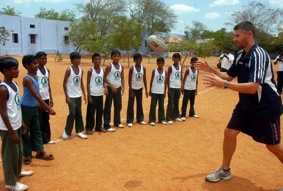 Originally from Adelaide, but now based full-time in the UK, Rick Shrowder has been a driving force behind footy in England’s North East for some years now.
Besides this, he is also one of the founders of GCS – Global Community Sports, an organisation using Australian rules football to connect with young students both in the UK and India.
Shrowder explains that Global Sports Global Learning is a project that is using sport to creatively engage with young people. The project, offered both through schools and also through young offender institutes, introduces the students to the sport of Australian Football and then works with the students to create a sports coaching manual documenting their experiences of the project. This manual is then sent to a group of young people in Madurai, a city of around 1.5 million inhabitants in the state of Tamil Nadu, south India. These students then use the manual to learn about Australian Football and report back to the students here about their experiences. It is a six week project involving both practical and class based sessions.
However, whilst the project is using sport as a vehicle to engage with young people, it is more than just a sports project. The project actually explores topics such as global learning, community cohesion, diversity as well as clearly benefitting literacy skills and contributing to improved attendance and behaviour. Issues such as bullying, success and achievement and barriers people face in sport are also addressed.
Shrowder says, “I have been introducing young people and adults to Australian Football since about 2006. The above project alone has been delivered to approximately 1350 young people in over 35 different schools and institutes in England in the last 2 years. It has also provided an opportunity for approximately 450 young people in and around Madurai in South India to experience the benefits of Australian Football. These young people have all been from areas of poverty and deprivation and in some areas where child labour is still an issue.”
“My motive behind creating and delivering the project is partly to share my love of Australian Football but also to show how with a bit of creative thinking the sport can really be used as a very effective, life changing educational tool. We are providing opportunties for employment and the development of real life skills both here in England and in south India using Australia’s greatest game.”
“My ambition is too see more schools in England participating in the program and experiencing Australian Football and then sharing this experience with other young people in other parts of the world.”
The program in India has also received some local press coverage, with the article Going for the goal appearing in The Hindu in September last year. The AFL India does not yet have an outpost in the state of Tamil Nadu, but Shrowder is in contact with them and is hoping to further develop a mutually beneficial relationship.
It’s footy, mate!
Posted on Monday, February 17, 2014 by ARFAI,
Courtesy: thesundayindian.com
Published: 1st November, 2011.
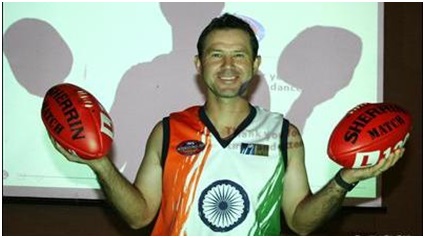 The game arrived in India in 2008 when Aussie cricket captain Ricky Ponting promoted it during his stint with the Kolkata Knight Riders. Since then, a team from India (there is no national team yet) has participated in two World Cups in Sydney. A governing body has also been set up with the team’s 21-year-old captain, Sudip Chakraborty, as the president.
Sport theorists link Australian football, also called footy, to Gaelic soccer. It was basically a modification of rugby that was brought to Australia by the early Irish and European settlers. Others are of the opinion that the game was developed by Australian cricketers to stay fit. In fact, many Australian cricketers like Shane Warne play the game in the off season.
The first recorded Australian Rules football match took place in 1858 and the first set of rules was codified a year later. The rules of the game resemble those of rugby, American Rules football and soccer.
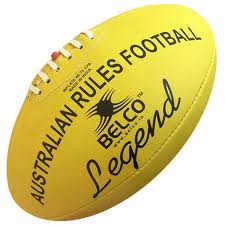 Chakraborty explains that the Australian football is split into four quarters and is played on an oval field one-and-a-half times the size of a soccer ground. There are 18 players on the field per team. Each team tries to score through two sets of four poles on either end of the field. The ball is moved along by kicking or punching it. Throwing is not allowed.
A player is allowed to carry the ball only for a distance of 10 metres after which it has to be put on the ground or bounced. “This is tricky because given the shape of the ball, bouncing it and then catching it again is not the easiest of things,” says Chakraborty.
The game starts with the referee throwing the ball up in the air. The tallest members of the two teams, known as ruckmen, try to grab the ball off the air, quite in the manner of basketball players. If the ball goes out of play, it is thrown back in by the linesmen, who do so without looking at the field. Tackling is allowed like in rugby, but is limited to frontal challenges between the shoulders and knees provided the player has the ball or is within a five-meter radius of the ball. Fouls are penalised with free kicks or distance penalties.
When the game started in India three years back, its potential was obvious. So, when the first team was formed, several organisations like West Bengal Kabaddi Association (WBKA) and YMCA supported it. They provided the grounds and initial infrastructure. However, when India team returned from its first campaign in the World Cup without a win, these bodies lost interest.
Says WBKA’s Pranab Bhattacharya: “I am from the world of football and was, therefore, very enthusiastic initially. However, once India returned from the World Cup, we realised the game would be difficult to promote here. Where would we get fields that are nearly twice the size of football grounds?”
Some Scepticism, says Bhattacharya, also stemmed from the fact that Indians would be at a distinct disadvantage in a sport that calls for great strength and stamina. “We cannot compete with the sturdy foreigners. You cannot play without 18 strong and fit boys on each team. So we chose to distance ourselves from the game,” he says.
The players, however, beg to differ and are going all out to promote the sport. AFL-India has not yet been ratified by the government. “We need a presence in five different states for that to happen. So far, we have boards in West Bengal and Kerala. Work has been done in Gujarat, Maharashtra and Tamil Nadu and we hope to set up boards in there soon,” says Chakraborty.
The Kerala board has already been ratified by the Kerala Olympic Association, thanks to the efforts of Rajiv Tharani, sports co-ordinator of the Olympic Association of Kerala. He says: “Kerala was the first state to register an Australian Football organisation in India in 2009. PA Hamsa is the president. We are planning to rope in people from neighbouring states, including footballers from Goa, and float a South Indian platform soon.”
Australian football has an instantly populist feel to it. Like football, cricket and hockey, the lay public can play it almost anywhere and with any equipment. However, unlike hockey or football, this game is still evolving globally and so there is far less competition.
“We have lost out in the other contact sports because there was already a very strong international structure in place. So we could not compete. This game, on the other hand, is in the nascent stages in most parts of the world. Thus, if we are able to form our strategy and make a place for ourselves now, it will be much easier for us to make a mark,” explains the India team captain.
“The physical disparities will always remain but it can be surmounted with other skills. For example, the Japanese team has players of average height. However, they beat others through superior speed. The Indian team is very strong when the ball is on the ground. We are weak in long passes but on the ground, we are better than most teams. This can be utilised to our advantage,” he feels.
Infrastructure has quickly evolved in India. For one, the balls that are used internationally are made mostly in Jalandhar. “Earlier, we would ship in the balls that were exported from Jalandhar to Australia. Now we get them directly from Jalandhar with the AFI logo printed on them.” says Tharani.
Moreover, India has no dearth of cricket grounds which could be used for footy. They are of the required size and shape. In fact, most cricket fields in Australia are used for this sport in the off season.
Australia has of course been hugely enthusiastic about promoting the sport in India. The first Indian team that went Down Under was supported in a big way by AFL with funds, playing kit and jerseys, training facilities and official dinners.
 Brett Kirk, a legendary retired Australian player of the game and now the international ambassador for the sport, came to India to hold several clinics in Kolkata, Mumbai and Punjab. In fact, it is he who discovered the ball manufacturing units in Jalandhar.
That apart, a massive campaign is about to be launched at the school level by the Australian company AussiX, which runs a training programme in Canada, where they have initiated more than 70,000 school students in the game.
An AussiX official says: “In India, we will focus on sports that interest the local community (not just Aussie Rules), and our model is to partner with sports service providers (NGOs).” AussiX’s first partner is the Abhinav Bindra Foundation.
“Bharatiya Vidya Bhavan School has 117 outlets throughout India. Ryan International School has a similar number. We have approached them. They will help us popularise the sport. Once that set-up comes through. AussiX will be running the programme in these schools,” reveals Chakraborty.
There are Indian supporters as well. Mega Cabs, Kolkata is providing a complete complementary cab service in the city for promoting Australian Football League – India. “MLA Sudip Bose helped us with the CA block ground for practice. We have also introduced the West Bengal sports minister Madan Mitra to the sport. Another big support is Railways minister Dinesh Trivedi,” Chakraborty says.
As the Aussies would say, it’s all happening out there!
AFL – Indian Team Finds Sponsors, Scripts First Ever Win In International Arena
Posted on Monday, February 17, 2014 by ARFAI,
Courtesy: sportzpower.com
Published: 18th September, 2011.
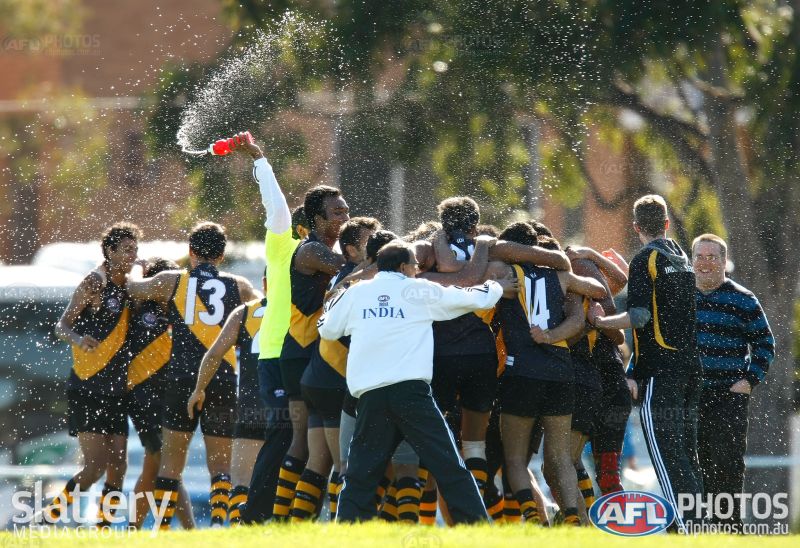
NEW DELHI: The nascent Indian team of Australian Rules Football came back having scripted its first ever win in any international match, that too, the apex in the sport, the Australian Football League, playing against 17 other countries, and managed to keep its sponsors happy.
India moved through the tournament developing the performance every match, against New Zealand, Sweden, China, France, East Timor and Peace Team (Israel & Palestine combined).
The match against China was very close, with India ahead in the 1st quarter. But the injury of one of the teammates, which took him directly to the hospital, probably let the moral of the team down a little. But the news read next day that ‘China snatched a big victory away from India’.
But the historic first ever win came on 24 August, when India beat Timor Leste (East Timor) 60-52.
The sponsorship response has been extremely enthusiastic, says Sudip Chakraborty, 21, secretary general of Australian Football League-India, of which the biggest contribution has been from the League organisers themselves.
Beside, Bharatiya Vidya Bhavan – Australia came in with a lot of sponsorship in kind, along with Lingona Pty Ltd (an Australian mining company); Richmond Football Club (AFL club); Celebrate India, the Indian tourism lobby firm; Australia India Society; Virgin Airlines; and Speedy Promotions.
A few businessmen from Kolkata also chipped in with money in their private capacity.
Chakraborty says that the work ahead for the sport is to spread it to a minimum of five states and establish state federations, so that it is within the basic legal framework of applying for becoming a national federation for this sport, which is just three years old in the country.
At the moment Kerala and Tamil Nadu has seen some work on getting exposed to the sport and finding enthusiastic players, but the hard work liesahead, Chakraborty told SportzPower.
« Previous
1
…
21
22
23
24
25
Next »













.jpg)